

Tapio RQP Live roll hardness profiler
Find roll defects before your customer does
Tapio RQP Live is a handheld roll hardness profiler for paper, board, plastic film and foil rolls. It measures a continuous hardness profile across the roll width, gives a pass/fail result on the device right away and transfers the data to the included Tapio RollView software.
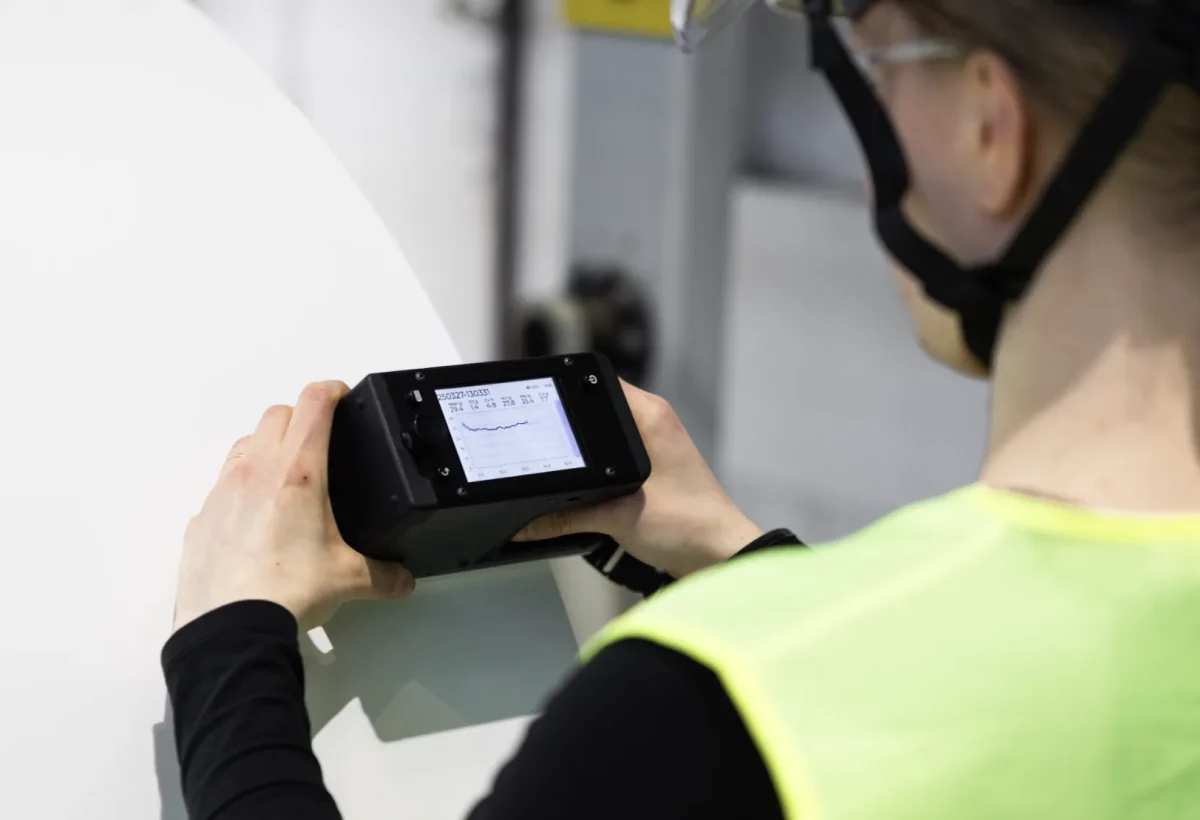
A roll can look perfect from the outside and still contain soft edges, streaks or uneven winding tension that turn into wrinkles, web breaks and customer complaints in unwinding, printing or converting. Knocking with a stick or taking single-point readings only samples a few positions. RQP Live records the complete profile and calculates its statistics, such as mean, standard deviation and CV%, so rolls are easy to assess and compare.
Problems RQP Live finds
Roll hardness reflects how tightly the material is wound, and the tension, thickness and density variation built into the roll. A uniform roll gives a flat profile. Deviations show where the problems are.
Soft and loose edges
Edges and edge rolls are often softer than the middle. The profile shows where the hardness drops below an acceptable level and how wide that zone is.
Streaks and narrow soft zones
Loose streaks and rope marks can be narrow. A 40 mm soft streak can fall between spot checks taken every 100 mm; a continuous profile records it.
Tension and thickness variation
Hardness follows the caliper and tension profile. In plastic film applications, hardness correlates closely with gauge.
Bagginess and wrinkles
Baggy or loose areas in film and paper webs show up as clear deviations in the hardness profile, before the roll is unwound.
Tilted profiles
A slope across the roll width points to thickness variation or alignment problems in winding.
Rolls wound too loosely or too tightly
Mean hardness against the limits set for your grade shows whether the whole roll is out of range.
What the profile reveals
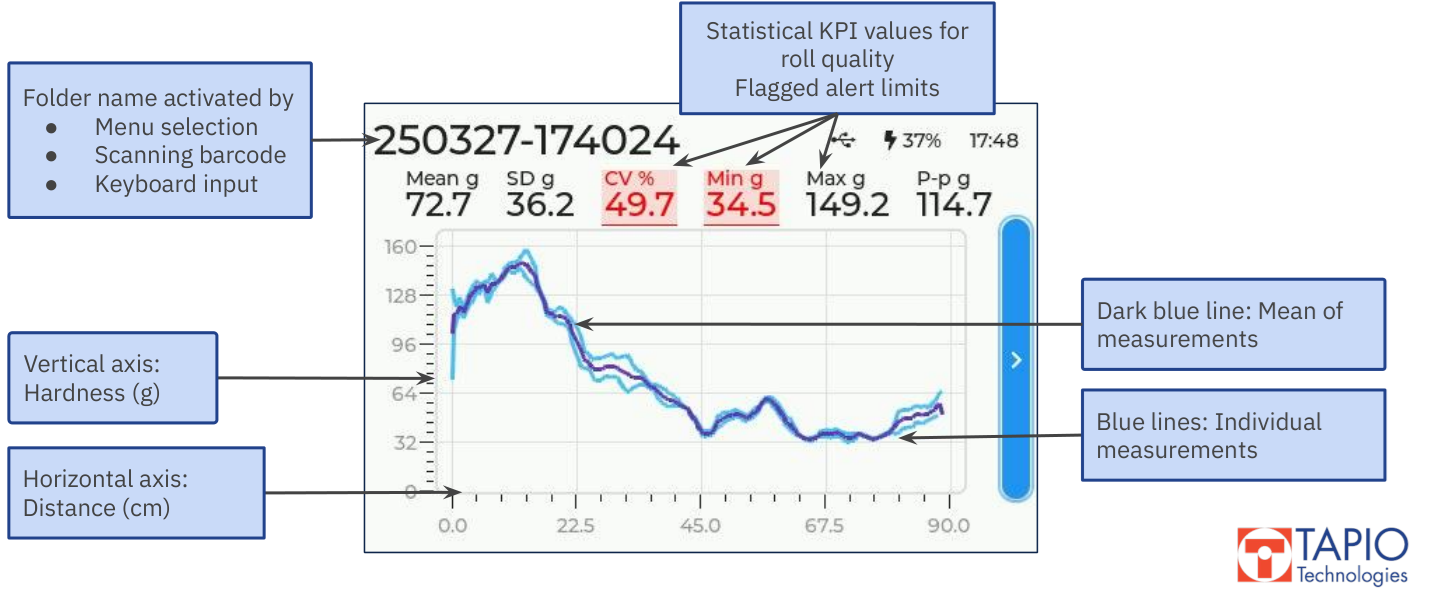
A tilted profile with high variation
The mean hardness of this roll is 72.7 g, but the CV% reaches nearly 50%, with values from 34.5 g to 149 g. The profile is clearly tilted. Later analysis traced it to excessive thickness variation in the rolled plastic.
Alert limits on the device and in Tapio RollView flag rolls like this automatically. You set the limits to match your product requirements.
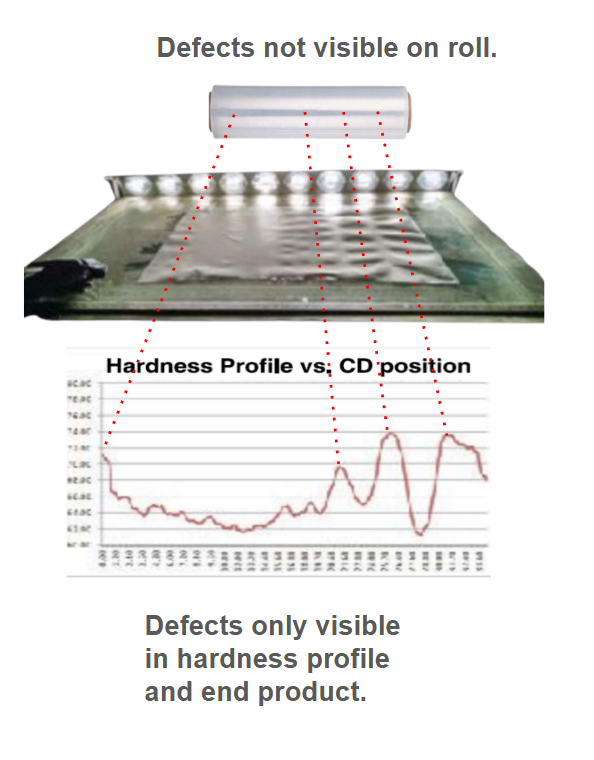
Hidden tension variation in film rolls
This plastic film roll showed no surface defects. When it was unwound, inconsistent winding tension showed up as stretched, baggy film. The baggy areas matched the deviations in the hardness profile.
In a polyethylene film roll, hardness followed the thickness profile: where the film was thinner, the roll was softer. Measuring hardness and thickness together helps trace the variation back to production parameters.
How it works
- 01
Identify the roll
Scan the roll's barcode or type its ID. The device creates or opens a folder for that roll.
- 02
Run the profiler across the roll
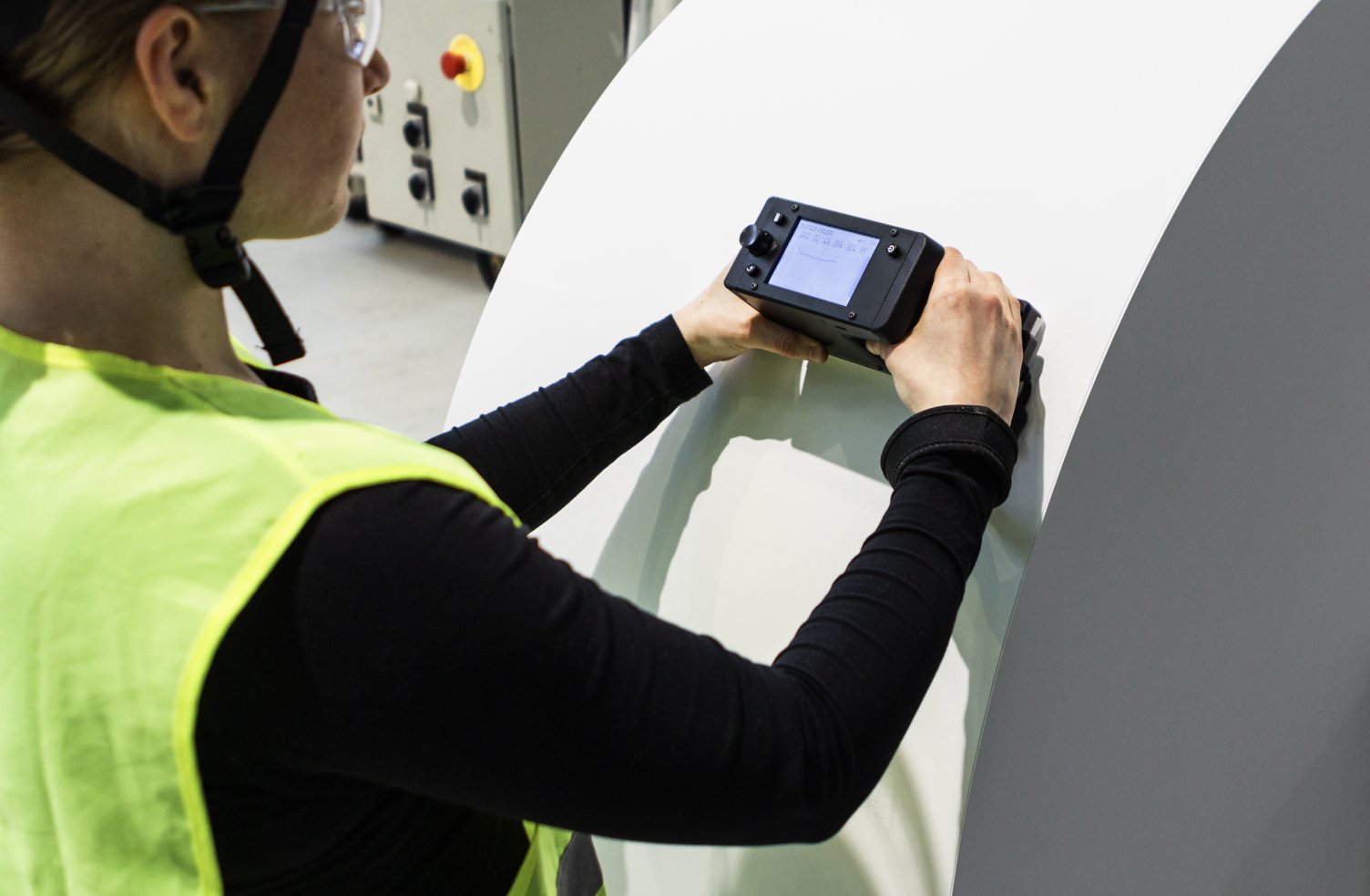
An impact hammer strikes the roll surface about 30 times per second while a wheel measures the position. Hardness is calculated from the deceleration of each impact, so the result does not depend on the operator's angle or technique. At the recommended speed of about 15 cm/s, a full-width profile typically takes less than a minute.
- 03
Accept or reject at the roll
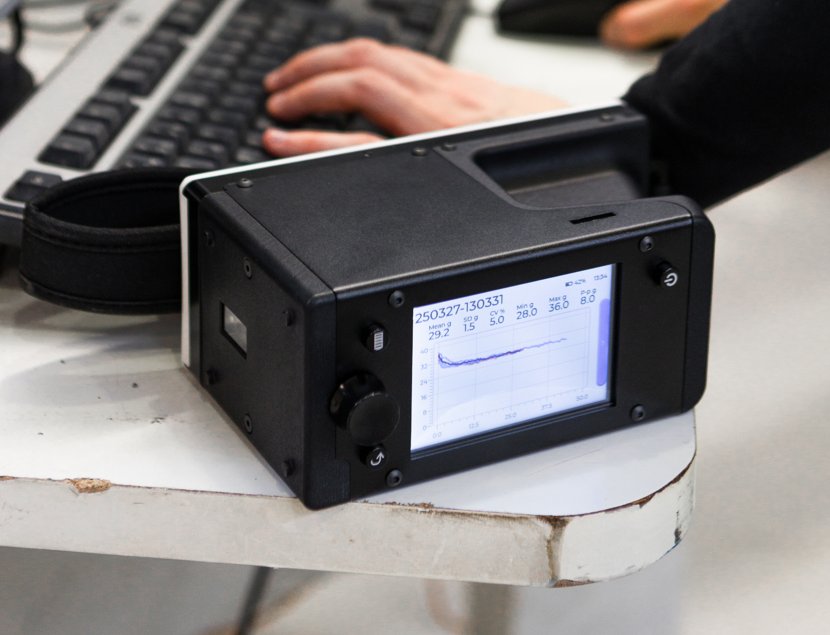
The display shows the profile with mean, standard deviation, CV%, minimum, maximum and peak-to-peak. Values outside your alert limits are flagged in red. Measure several passes and the device also shows their mean profile.
- 04
Synchronize to Tapio RollView
Transfer the profiles over Bluetooth or USB C. RollView's postprocessors create Excel sheets, machine-readable files and images automatically, and custom postprocessors can send the data to your own systems.
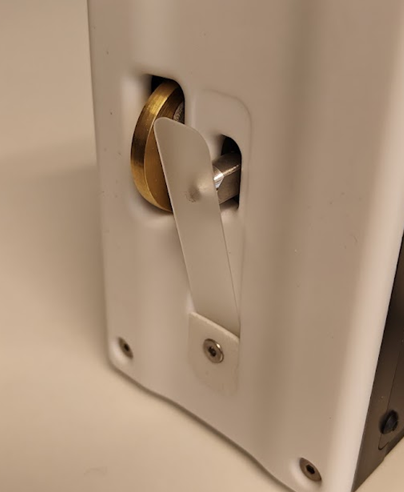
Built for the production floor
- One-button measurement and a live profile on the integrated 3.5″ display
- Factory-calibrated; analysis zone filters let you evaluate only the relevant part of the roll
- A first-time user can measure rolls successfully, and commissioning needs minimal training
- Lightweight at 1.25 kg, with no network configuration
- Alert limits and other device settings can be loaded from a QR code made with the RQP Live Configurator Tool
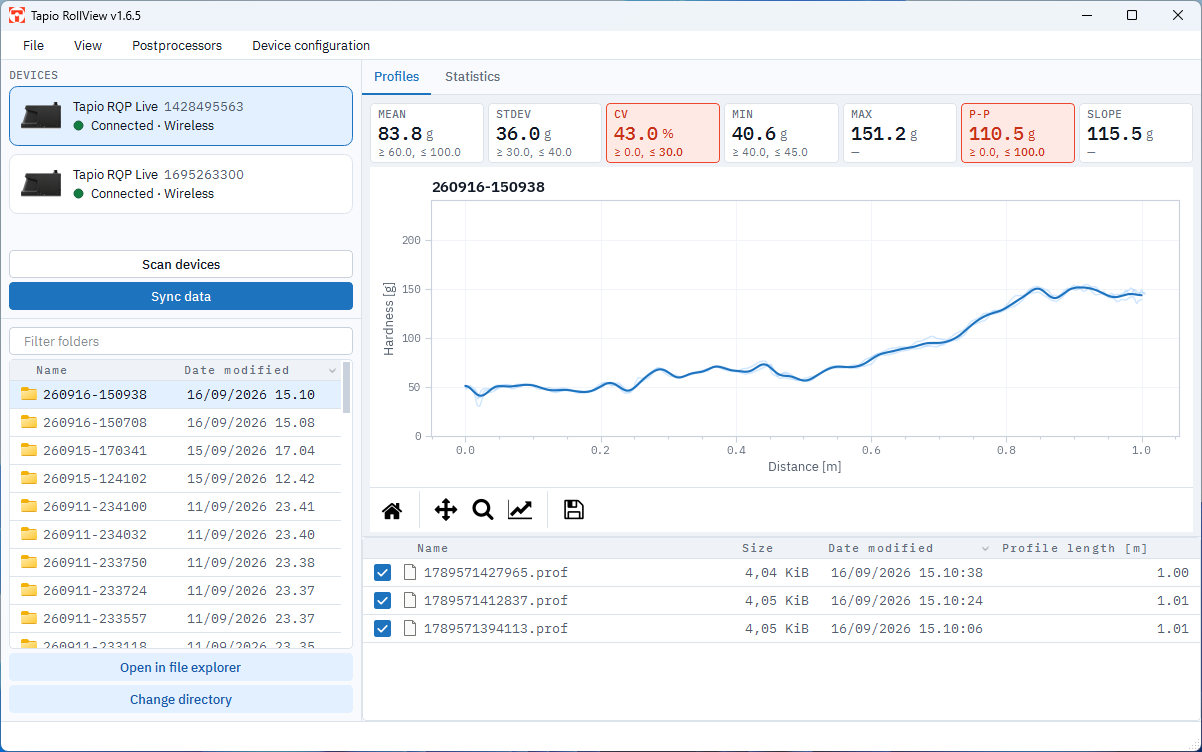
Tapio RollView is included
RollView is free, open-source PC software for synchronizing, viewing and processing RQP Live data. Join the rolls of a winder set into one continuous profile, apply alert limits, study the spectrum of periodic variation and export the results to other systems.
Source code and the manual are on GitHub.
Applications and materials
RQP Live measures any roll large enough to support the device, from 10 cm to 5 m in diameter and from 10 cm to 20 m long:
- Paper and board rolls, plastic rolls and customer rolls
- Parent reels and machine rolls
- Roll cores; roll ends can also be measured
Because it measures the finished roll, it verifies quality after production, winding, transport and storage, without online sensors.
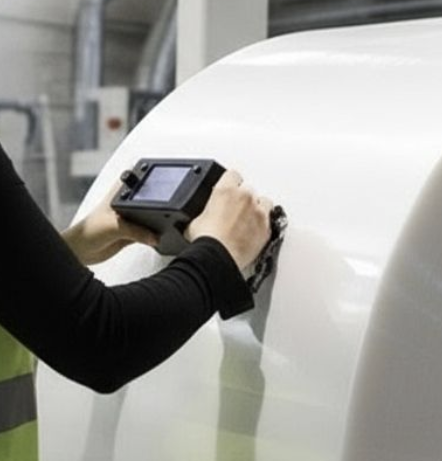
Paper and board
- Consumer packaging board grades; sack, kraftliner and fluting
- LWC, one of the most common grades among RQP users, to optimize the slitting process; also widely used for SC grades
- Newsprint, where printing press runnability needs high-quality rolls and tightness near the core is especially important
- Release paper, where customers have also opted for an automatic online profiler
- Follow-up of QCS performance by verifying cross-direction profiles
- Adjusting calendering pressure and the caliper profile with hardness profile feedback
Plastic films
- Flexible packaging: BOPP, BOPET, BOPA (nylon), PE, PP, PVC and PET
- Blown and cast film
- Technical and special films
- Tension and thickness variation across thin, medical and industrial films
- Hardness correlates closely with gauge, caliper and thickness in film applications
Metal foils
- Aluminum foils for food and pharmaceutical packaging
- Copper foils for electronics and printed circuit boards
- Laminates combining foils with polymers or paper
- Very sensitive to tension and thickness variation
Battery films and foils
- Separator films and coated separators
- Cathode and anode foils
- Essential in film production, where caliper uniformity directly affects performance and safety
Technical specifications
| Specification | Tapio RQP Live |
|---|---|
| Measurement principle | Deceleration of an impact hammer, measured together with position |
| Measurement rate | About 30 impacts per second |
| Sampling step | 1 mm |
| Full-width profile | Typically less than one minute at the recommended 15 cm/s |
| Roll diameter | 10 cm – 5 m |
| Roll length | 10 cm – 20 m |
| Profile statistics | Mean, standard deviation, CV%, min, max, peak-to-peak, with alert limits |
| Impact force | Adjustable |
| Display | Integrated 3.5″ display with live view |
| Roll identification | Barcode scanner or keyboard input |
| Data transfer | Bluetooth or USB C; no network configuration needed |
| Companion software | Tapio RollView, free and open source, with postprocessors |
| Battery | Up to 15 hours; about two hours to charge with a USB C Power Delivery (20 V) charger |
| Calibration | Factory-calibrated; calibration check sample available as an accessory |
| Weight | 1.25 kg |
| Dimensions | 7.3 cm × 19 cm × 11 cm (width × length × height) |
Download the RQP Live datasheet (PDF)
Spot checks or a continuous profile?
| Spot measurement (stick, rebound hammer) | Continuous profile (Tapio RQP Live) | |
|---|---|---|
| What you get | Sound and feel, or one value per chosen point | Hardness against position across the full width, at a 1 mm sampling step |
| Narrow defects | Can fall between the measured points | Recorded in the profile |
| Operator dependence | Depends on spacing, positioning and impact technique | Independent of operator angle and technique; comparable between operators and shifts |
| Statistics | Hardness level only | Mean, standard deviation, CV%, min, max and peak-to-peak |
| Decision | Operator judgement or manual records | Pass/fail against alert limits during the measurement |
| Data | Recorded separately | Stored per roll, synchronized to RollView and exported |
Spot checks still have their place for quick, informal checks. For roll acceptance, repeatability between operators and process improvement, you need the profile.
Read the full roll hardness profiler comparison
Results from mills and converters
Paper mill: edge rolls caught before shipment
Problem: Converter rejects were traced to certain rolls, but the mill had no reliable way to identify them before shipment.
Measurement: Every customer roll was profiled with RQP Live at the rewinder. RollView continuous mode joined the set of eight rolls from the winder into one profile.
Finding: Mean hardness was practically the same for every roll. CV% clearly separated the edge rolls and matched the rolls rejected at the customer.
Action: Based on earlier rejected rolls, the mill set a CV% alert limit of 5%.
Plastic film: about 25% of rolls rejected in converting
Problem: Around 25% of a film producer's rolls were rejected by the customer in converting. The rolls looked normal, and visual inspection and process data did not explain why.
Measurement: Each roll was measured with RQP Live at the rewinder, and the profiles were combined in RollView continuous mode.
Finding: One edge roll measured about 31 g against 38–39 g for the rest, matching the rolls that later caused converting problems. Only the middle of that roll was soft, a pattern single-point testers may not reveal.
If you want to understand the real CD profiles of paper and identify the source of variation, Tapio roll hardness measurements are extremely valuable. They reveal systematic process variations that are difficult or impossible to detect with online scanners.
— Pekka Komulainen, Independent Consultant, Pele Oy
When RQP Live is the right choice
Choose RQP Live when:
- roll acceptance decisions matter and need to be documented
- narrow defects must be found, not only the average hardness
- operators need live feedback and pass/fail alert limits at the roll
- the data will be analyzed further, exported or sent to a quality system
- you measure paper, board, plastic film, technical film, foil or battery material rolls
Already have an online QCS scanner? The scanner measures the moving web; RQP Live verifies the wound roll, which reflects material properties, tension variation and winding quality together. If the roll profile and the scanner disagree, Tapio Analysis can separate MD and CD variation in the laboratory.
Competitive pricing
A cost-effective way to bring objective roll quality control to the production floor.
Dedicated support
Tapio's maintenance and service keep your devices running smoothly for years.
Over 20 years of roll profilers
Tapio Measurement Technologies has been producing roll quality profilers for over 20 years.
Frequently asked questions
What is roll hardness and why does it matter?
Roll hardness describes how tightly a material is wound into a roll and reflects its internal stress and structure. It cannot be judged reliably by visual inspection, yet it directly affects how the roll behaves downstream.
Both the hardness level and the hardness profile across the roll (CD) matter. Variation across the width leads to uneven tension and to defects such as wrinkles, blocking, deformation or edge damage in unwinding, printing or converting.
What causes roll hardness variation?
Mainly the CD profiles of basis weight, moisture and caliper, which change how the material compresses during winding. Winding conditions such as tension, nip load and torque control, machine factors and process disturbances such as speed changes or splices also contribute.
How do I tell a good roll from a bad one?
A perfectly uniform roll gives a flat profile. The device reports mean hardness, standard deviation, CV% (coefficient of variation), minimum, maximum and peak-to-peak range. In many applications CV% is a strong overall indicator of roll uniformity. Acceptable limits must be defined per grade and process.
Does the measurement damage the roll?
No. The measurement is non-destructive. Light surface marks may sometimes be visible, but they do not affect roll performance.
How deep does it measure?
The impact reaches a few centimetres into the roll surface. In winding, however, even small CD variations accumulate in the same position, so the measured hardness variation reflects the whole depth of the roll.
Why measure hardness if we already have an online QCS scanner?
Online scanners measure the moving web during production. Roll hardness measurement verifies the finished roll, and hardness reflects the combined effect of material properties, tension variation and winding quality. With RQP Live, rolls can be measured after production, handling, transport and storage.
How is it different from other roll hardness testers?
It measures a continuous profile of hardness against distance at millimetre-level intervals instead of single points. The results are independent of operator angle or technique, and the system is built on modern electronics and software with a strong focus on usability and data handling.
What size rolls can be measured?
If the roll is large enough to support the device, there are no limits. RQP Live measures both small rolls (for example 25 cm diameter and 10 cm long) and large rolls (for example 3 m diameter and 10 m long).
How long does one measurement take?
The recommended measurement speed is about 15 cm per second, so the roll length determines the time. A full-width profile typically takes less than one minute.
How are roll IDs and profiles stored?
The device creates a folder for each roll, named with the keyboard or by scanning a barcode. Several profiles can be measured into each folder, and the device shows their average profile alongside the individual passes.
How is the data exported, and can it go to our own systems?
Profiles are synchronized to a computer with the open-source Tapio RollView software. Its standard postprocessors run automatically after each synchronization and create machine-readable data files, Excel sheets and images. Custom postprocessors can reprocess the data and transfer it to any location.
Is network configuration required?
No. The device is not connected to the internet. It connects directly to a computer over Bluetooth or the included USB C cable.
How long does the battery last?
Approximately 14 hours, and the charge level is shown on the display. Charging from empty to full with a compatible USB C Power Delivery (20 V) charger takes about two hours.
How is the device calibrated?
The device is factory-calibrated. The stability of the calibration can be verified with a calibration check sample, available as an accessory.
How do I know the measurement is valid?
Measure the same roll several times to confirm repeatability. With multiple passes, the device shows the mean profile of all passes for that roll.
Does using RQP Live require training?
Basic use is quick to learn. Some training helps with interpreting results and understanding what different profile patterns mean in your process.
What does RQP stand for?
Roll Quality Profiler.
Related articles
See RQP Live on your own rolls
Book a remote demo with our team or through one of our local representatives. We will show how a continuous hardness profile helps you accept or reject rolls in seconds.